By Geoff Shames9 min readStrategyPaid Media
Your 2026 Chart Forecast Is Wrong by Two Thirds
Billboard’s new streaming ratio makes ad-supported listening worth 66.7 percent more album units from January 2027, and YouTube counts again. Here’s the math.
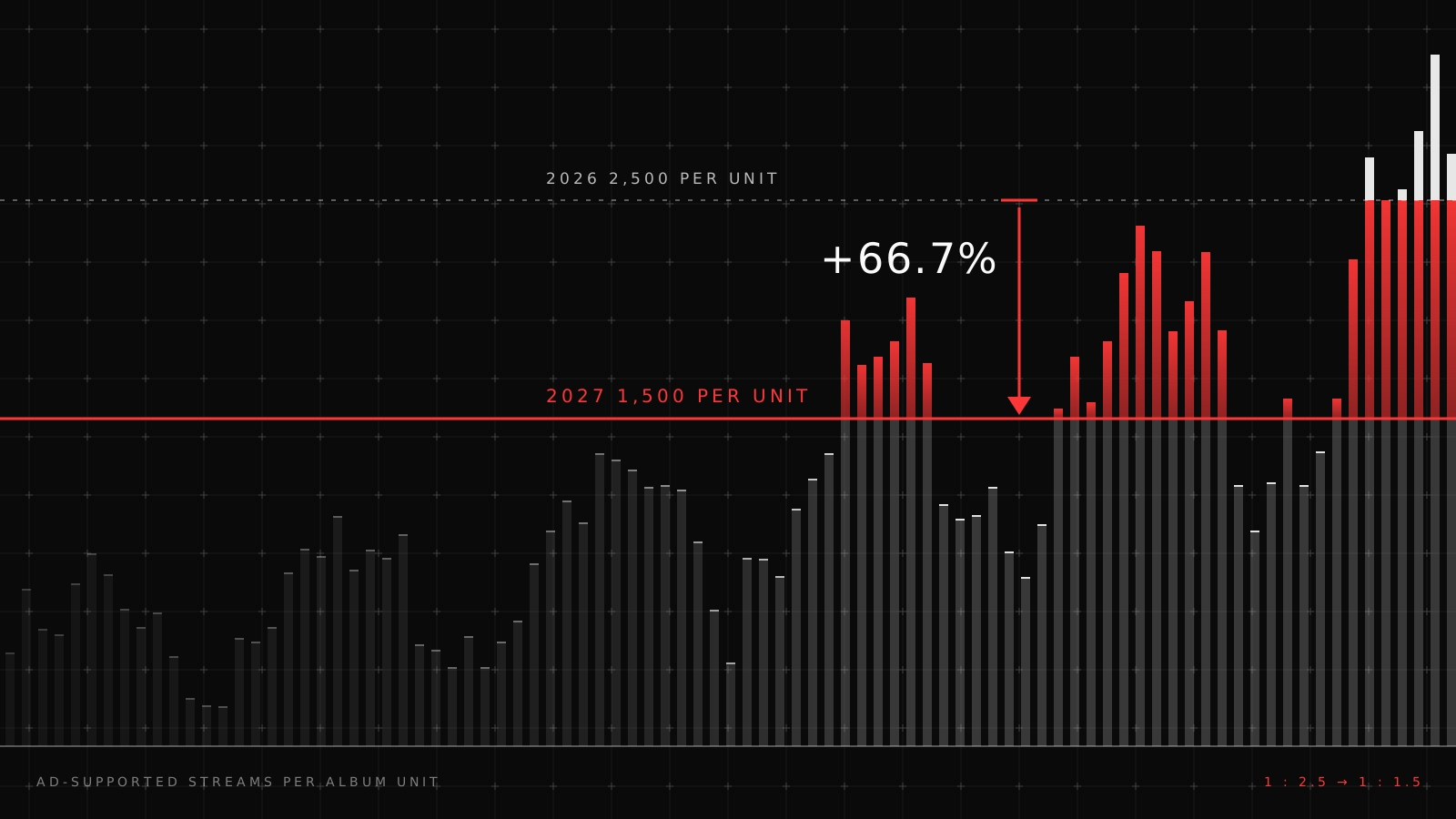
Billboard’s new streaming ratio makes the same ad-supported listening worth 66.7 percent more album units from January 1, 2027, and YouTube counts again in the same week. Here’s the re-forecast math, the stacked raise underneath it, and the playbook for re-timing a release.
[ 01 ]Key takeaways
- The ratio moves from 1:2.5 to 1:1.5. Billboard announced it on November 9, 2026, for the Billboard 200 and genre album charts, starting with the charts dated January 16, 2027.
- One album unit is now 1,000 paid streams or 1,500 ad-supported streams. The paid number doesn’t move. An ad-supported stream gets 66.7 percent heavier overnight.
- 10,000 units on ad-supported streams alone drops from 25 million streams to 15 million. Same fans, same listening, 10 million fewer streams required.
- It’s the second narrowing in a row. Against the formula in place through 2025, an ad-supported stream is now worth 2.5 times what it was. A paid stream gained only 1.25 times.
- YouTube comes back on the same chart date, after sitting out most of 2026. Two changes land in one tracking week, and neither one is in your current forecast.
- Our read: any projection built at 1:2.5 is lowballing a YouTube-heavy, free-tier-heavy release. The ad-supported side will come in about two thirds higher than the plan says.
[ 02 ]The short version
The Billboard streaming ratio change isn’t a news story. It’s a forecasting error sitting inside every 2027 release plan built this year. On November 9, 2026, Billboard narrowed the ratio between paid subscription streams and ad-supported streams from 1:2.5 to 1:1.5, and YouTube confirmed the same day that its data comes back to the charts in 2027.
Twenty-plus outlets covered it. Almost none of them did the math on what it does to an actual release. That math is the story, because it changes which week you drop, where you spend, and what number you promise your label. We re-forecast releases for artists at Crowd Control Digital, so here’s the evidence, the economics, and the playbook.
[ 03 ]What changed on November 9?
Billboard changed how many streams it takes to make one album unit on the Billboard 200 and its genre album charts. Under the new formula, 1,000 paid subscription streams or 1,500 ad-supported streams equal one album unit, down from 2,500 ad-supported streams today. The paid threshold stays at 1,000.
The new ratio kicks in with the charts dated January 16, 2027, which reflect listening from January 1 to January 7. Billboard said the change follows its annual review of streaming revenue data with Luminate, and that the new ratios are based on revenue from paid and ad-supported streaming.
| Rule set | Paid streams per unit | Ad-supported streams per unit | One paid stream equals |
|---|---|---|---|
| Through 2025 | 1,250 | 3,750 | 3 ad-supported streams |
| Current, through 2026 | 1,000 | 2,500 | 2.5 ad-supported streams |
| From charts dated Jan 16, 2027 | 1,000 | 1,500 | 1.5 ad-supported streams |
On December 16, 2025, Billboard had already narrowed the ratio from 1:3 to 1:2.5. YouTube said that wasn’t enough, and its data has been missing from the charts since the ones dated January 31, 2026. January is step two of a two-step raise, and it’s the step that brought YouTube back.
[ 04 ]The re-forecast math
The same ad-supported listening produces 66.7 percent more units under the new formula, because 2,500 divided by 1,500 is 1.667. The coverage that did run the number landed in the same place: an ad-supported stream gains about 67 percent more weight, while a paid stream still counts 1.5 times as much as an ad-supported one.
Run your own catalog through it:
| Ad-supported streams in one tracking week | Units today (1:2.5) | Units from Jan 2027 (1:1.5) | Lift |
|---|---|---|---|
| 15 million | 6,000 | 10,000 | +66.7% |
| 25 million | 10,000 | 16,667 | +66.7% |
Most real releases are a mix. Take a week with 5 million paid streams and 15 million ad-supported streams. Today that week is worth 11,000 units: 5,000 from paid, 6,000 from ad-supported. From January it’s worth 15,000: 5,000 from paid, 10,000 from ad-supported. That’s a 36 percent lift with zero change in listening, zero new fans, and zero extra spend.
Flip it around and the planning number gets sharper. If your chart goal is 10,000 units from ad-supported listening alone, you need 25 million streams this year. From January 1, 2027, you need 15 million. Any release plan still carrying the 25 million target is over-buying reach by 10 million streams.
[ 05 ]The stacked raise nobody priced in
One narrowing is a tweak. Two in a row is a repricing. Through 2025, it took 3,750 ad-supported plays to make one album unit. From January it takes 1,500. That’s a 2.5 times jump in chart value in about a year. A paid stream went from 1,250 to 1,000 per unit over the same stretch, a gain of only 1.25 times.
The strategic read: the chart value of free-tier, ad-supported audiences has gone up twice as fast as the value of subscribers. Artists whose listening skews young, international, and free-tier have been undercounted for years next to subscription-heavy catalog acts. That gap doesn’t close in January, but it narrows more in one week than it did in the previous decade. If your audience lives on free tiers, your chart ceiling just moved, and your competitors’ forecasts probably haven’t.
[ 06 ]YouTube is chart-visible again
The ratio is only half of the January change. YouTube’s global head of music, Lyor Cohen, confirmed the return in an update to the same blog post he used to announce the exit: “We are returning to the Billboard charts starting in 2027. Billboard’s new methodology better reflects how fans engage with music today across both subscription and ad-supported services.”
For most of 2026, YouTube listening earned zero Billboard 200 credit. Video premieres, official audio uploads, and the viewing habits of fans who never open a streaming app were invisible to the album chart. From the January 1–7 tracking week that listening counts again, in the same week the ad-supported streams it generates get 66.7 percent heavier. A YouTube-led release gets both changes at once. If you pulled budget off YouTube in 2026, don’t just put it back. Re-model it, because the platform comes back at a different exchange rate than the one it left at.
[ 07 ]The honest caveats
Three caveats before you rebuild anything.
This is chart conversion only. The ratio changes how streams become units. It does nothing to per-stream royalty rates, which follow separate licensing and distribution terms. A release can chart higher in January and earn exactly the same streaming revenue.
Two rulebooks are still unpublished. Billboard’s announcements didn’t include the Hot 100 song-chart weights under the new methodology, so every number in this article is an album-chart number. And neither announcement said which YouTube stream types are eligible. Model the YouTube return as significant but unquantified until those details land.
Nobody gets the blackout year back. YouTube data missing from the charts through 2026 stays missing. There’s no retroactive fix, which means year-over-year chart comparisons across 2026 and 2027 carry a built-in distortion. Say so in every report you send, before someone else uses it against you.
[ 08 ]The playbook
1. Rebuild the forecast at 1:1.5 this week
Split your projected streams into paid and ad-supported before you convert anything. A blended streams-to-units shortcut built at 1:2.5 lowballs a free-tier-heavy release, and the ad-supported side will land about two thirds higher than it says. The worked examples above are your template.
2. Re-time the promo peak, not just the release date
The first tracking week that gets both the new ratio and YouTube back is January 1–7, 2027. A late-December release whose promo peaks in that week catches the new math on its biggest listening days. Model both formulas before you lock any December or January date.
3. Put YouTube back in the chart budget
Video and official audio earned no Billboard 200 credit for most of 2026, so most teams cut it. From January it counts again, at the heavier ad-supported rate. Rebuild the YouTube line at the new exchange rate instead of restoring the old spend out of habit. (If physical is part of the plan too, our Billboard smart media breakdown covers that side of the chart rules.)
4. Renegotiate chart targets in writing
Goals set with a label, distributor, or brand partner this year were priced at 1:2.5. A 10,000-unit target that needed 25 million ad-supported streams now needs 15 million. Get the revised number agreed before release week, not argued about after it.
5. Flag the comparison problem in every report
2027 debuts will look inflated next to 2026 debuts for two mechanical reasons: the ratio and the YouTube return. Write the caveat into your reporting template now, so the lift reads as methodology and not as a claim you have to defend later.
6. Watch for the two missing rulebooks
Hot 100 weights and YouTube eligibility specifics are unpublished as of this writing. Put someone on Billboard’s methodology pages weekly through December. The team that models the song-chart numbers first plans the singles strategy first.
[ 09 ]FAQ
What is Billboard’s new streaming ratio?
From the charts dated January 16, 2027, one Billboard 200 album unit equals 1,000 paid subscription streams or 1,500 ad-supported streams. The ratio moves from 1:2.5 to 1:1.5. Paid streams keep their current value. Ad-supported streams gain about 66.7 percent more chart weight per play.
When does the new Billboard formula start counting?
It covers listening from January 1 to January 7, 2027, the first tracking week of the year. Those streams feed the Billboard 200 and genre album charts dated January 16, 2027. Listening in December 2026 still counts under the old 1:2.5 ratio, so release timing matters.
Does YouTube count toward the Billboard 200 again?
Yes, starting in 2027. YouTube confirmed on November 9, 2026 that its data returns to the Billboard charts after sitting out most of 2026. Billboard hasn’t published which YouTube stream types are eligible, so model the return as significant but unquantified until details land.
How much is an ad-supported stream worth under the new ratio?
On the album charts, 1,500 ad-supported streams now equal one unit, so each stream carries two thirds more weight than it does at today’s 2,500 per unit. Against the formula in place through 2025, when it took 3,750 ad-supported streams to make one unit, the gain is two and a half times.
Does the new ratio change what artists get paid per stream?
No. The ratio is a chart conversion rule only. It decides how streams become Billboard 200 units, not how money moves. Per-stream royalty rates still follow your label, distributor, and licensing deals. A release can chart higher in January 2027 while earning exactly the same streaming revenue.
How can Crowd Control Digital help with the 2027 chart changes?
We re-forecast releases for artists, creators, and brands. We rebuild your unit projections at 1:1.5, split paid and ad-supported listening, model the YouTube return, and flag the release dates where the new math changes the outcome. See our services, or bring us your current forecast.
[ 10 ]The bottom line
Billboard didn’t just adjust a formula. It repriced free-tier fandom for the second time in a year, and YouTube walked back into the chart in the same week. Every forecast, target, and release date built at 1:2.5 is now wrong in a specific, calculable direction. Recalculate before December, or spend January explaining a number you could’ve predicted.
At Crowd Control Digital, we build release forecasts and chart strategy for artists, creators, and brands, including re-forecasting under new chart rules before a release date locks. If your 2027 plan still runs on the old ratio, get in touch.